
Cedar County Projected Versus Actual Release
A projected release date is an administrative estimate. It reflects what the record and calculation support at a given time. An actual release date records when a custodian completed the movement. The two can differ. A court sentence-end date may not equal the jail’s physical release time, and a parole date may not result in immediate release when a detainer or an unapproved plan remains.
Pretrial detention is different. A person held while a case is pending has no ordinary sentence-completion date. Bond may be set, changed, posted, or denied. The court may dismiss a charge or order release, yet another warrant or agency hold can keep the person in custody. Case.net can reveal the legal event. The Sheriff’s booking and release record establishes when Cedar County processed the movement.
- Projected date
- A current administrative estimate based on the sentence and known credits, limits, and decisions.
- Actual release
- The dated event recorded by the custodian when the person leaves that custody.
- Detainer
- A request or legal hold that may send the person to another agency instead of the community.
- Time served
- Custody credited toward a sentence under the controlling judgment and calculation.
Find a Cedar County Release Date
Start by identifying the last known custodian. Cedar County Detention Center records control local jail custody. MODOC controls state-prison calculations. Another county, the Federal Bureau of Prisons, the U.S. Marshals Service, or immigration authorities may control a different case. Leaving Cedar County’s roster can mean transfer, not community release.
- Collect the full name, aliases, date of birth, booking or offender number, case number, and approximate custody dates.
- Read the judgment in Case.net or obtain it from the Circuit Clerk. Note the sentence start, jail credit, and whether terms run together or one after another.
- Check every known case and hold. A second county, warrant, detainer, or federal matter can control the next movement.
- For a local sentence, ask the Cedar County Sheriff for the existing release calculation or dated booking and release record.
- For a state sentence, search MODOC for the active record, then ask the institutional caseworker or parole office for the specific date calculation.
- Recheck near the estimate and obtain the actual release event from the custodian. Use notification only as a supplement.
The MODOC Offender Web Search covers active offenders and accepts first and last names, including aliases. It excludes discharged people and can withhold some active records. Its landing page does not promise a projected-release field on every profile. If a matched profile shows a date, record the exact field label and “as of” context. If it does not, use the institutional contact path rather than inventing or estimating a date.
For a local custody question, the complete Cedar County release-record search path explains how to match the Sheriff’s timestamp with the court disposition.
Do not substitute the Cedar County live roster for this process. A current listing can support present custody at the time checked, subject to lag and identity matching. An absent listing cannot supply a future date or prove a past release. Preserve the check time, then seek a positive calculation, transfer entry, or completed release record.
Cedar County Jail Date Calculation
A Cedar County jail sentence calculation begins with the written judgment. Identify the date the sentence commenced, all credit for time already confined, and each term imposed. Then determine whether multiple terms are concurrent or consecutive. Concurrent terms run at the same time. Consecutive terms run one after the other. Any lawful local credit must come from the actual judgment, statute, or written jail calculation.
No official Cedar County source reviewed states a general local good-time policy, a weekend or holiday early-release practice, or a standard hour for sentence-completion processing. The official detention page, under Sheriff James “Jimbob” McCrary when reviewed, describes jail operations but does not supply those release rules. Another county’s custom cannot fill that gap. Ask the Sheriff for the written policy in force for the relevant period or for the person’s existing calculation. If the answer is oral, request a dated record or written response.
Cedar County Sheriff’s Office202 South High Street
Stockton, MO 65785
Jail line: 417-276-5133, extension 251
Official Sheriff page
The Cedar County Circuit Clerk keeps the local court file. Contact the clerk when the judgment, amendment, or credit order is missing from public Case.net access. The jail can explain its own computation, while the sentencing court controls the judgment. Neither source should be asked to speculate about another agency’s hold.
Note: A court sentence end and the Cedar County Detention Center’s actual processing time may differ.
Missouri Rules for Cedar Release Dates
Missouri prison dates require more than subtracting days from a sentence. MODOC applies the judgment and credit, then accounts for statutory minimums, parole or conditional-release law, Board action, and later corrections. The familiar statement that a person must serve 85 percent is not a universal Missouri rule.
Section 558.019 addresses minimum prison terms for specified prior offenders and includes the 85-percent rule tied to specified dangerous-felony circumstances. Whether it applies depends on the offense, findings, prior commitments, sentence date, and other law. Section 217.690 provides the Parole Board’s core authority and eligibility framework, also subject to exclusions.
The Missouri Parole Board page links current rules and time-to-serve appendices. Those appendices give administrative context, not guaranteed dates. The Board reserves discretion within its lawful authority. Specific release-date questions are directed to the institutional parole office, which can work from the actual sentence record and computation.
The official Missouri Parole Board source image shows where its rules and guideline material are maintained.
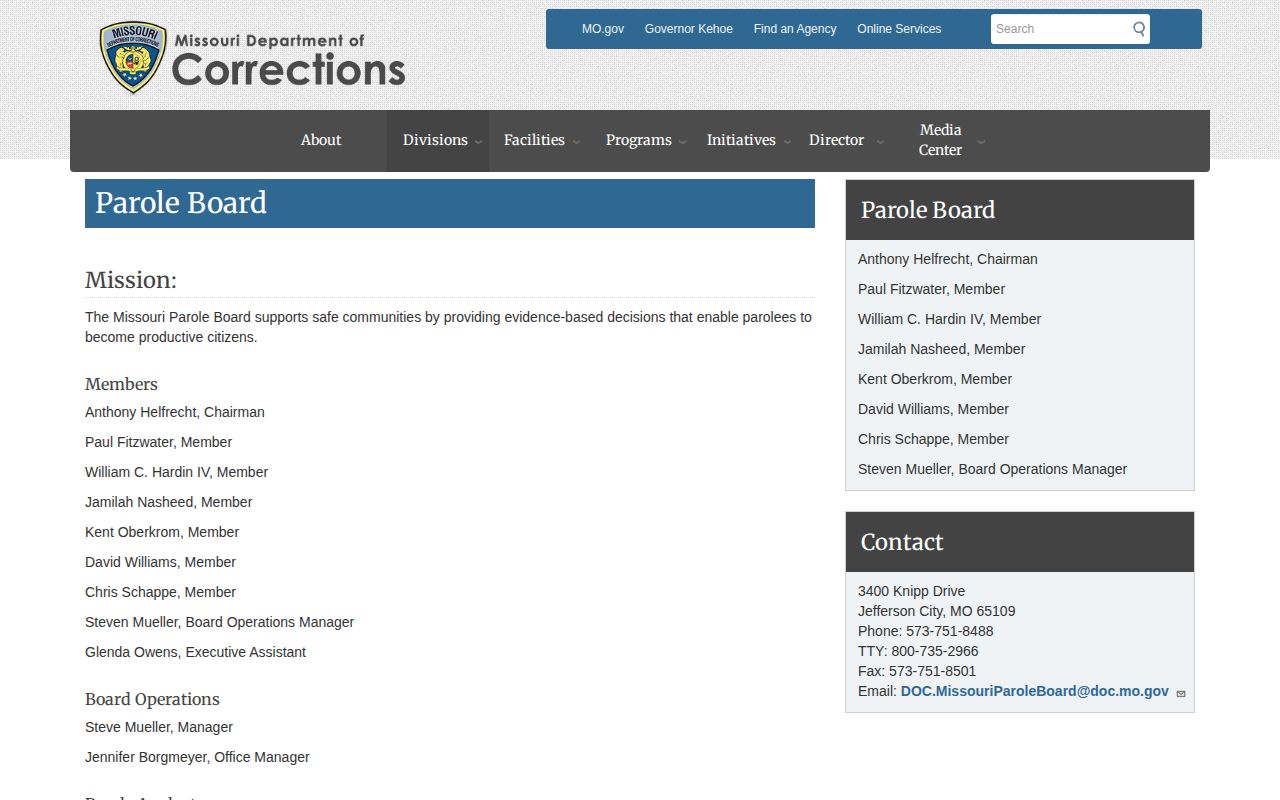
Always open the current Board page because rules, appendices, and contact directions can change after capture.
Why Cedar County Release Dates Change
A projected date can move in either direction when the controlling facts change. Some changes come from the court. Others arise from MODOC computation, discipline, parole review, or a new hold. The reason should be tied to an official entry rather than guessed from a shift on a screen.
| Change | Possible effect | Best confirmation |
|---|---|---|
| Corrected jail credit | Changes time counted as already served | Amended order and custodian calculation |
| Consecutive sentence | Adds a term after another term | Judgment and MODOC or jail computation |
| New detainer or warrant | May change destination or prevent community release | Holding agency and transfer record |
| Disciplinary or program action | Can alter credits or required steps where law allows | Institutional record |
| Board decision | May establish, deny, defer, reconsider, or change a date | Parole Board or institutional parole office |
| Appeal or court correction | Can alter the judgment or sentence basis | Case.net and signed court order |
| Revocation | Can return a supervisee to custody and trigger a new computation | Court, Board, and MODOC records |
A parole grant is one step, not a release receipt. A home plan, detainer, or other condition may still be unresolved. In the same way, a dismissal in one Cedar County case does not eliminate a hold from another county. The actual custody record remains the final event source.
Cedar County Court Release Controls
Cedar County belongs to Missouri’s 28th Judicial Circuit with Barton, Dade, and Vernon counties. The detention center also houses people for several counties. A person physically held in Stockton may therefore have a sentence, warrant, or release order controlled elsewhere. Searching only Cedar County can miss the controlling case.
Use Case.net to match the party, court, case number, filing date, charges, judgment, sentence, and later docket entries. “Disposed” means the court resolved the case at that stage. It does not certify when jail staff completed release. A bond entry also does not prove the door opened at that moment.
When the docket says the person was remanded or committed to MODOC, removal from Cedar County custody is a transfer. When bond was posted, another hold may remain. Ask the Sheriff record to identify the release disposition and destination or receiving agency. If another county controls the movement, follow that county’s court and jail records.
Request Cedar County Date Records
A narrow public-record request can resolve a missing calculation or old release event. Send the request to the agency that created the record: the Sheriff for Cedar County jail data, the Circuit Clerk or court for the judgment, and MODOC for state incarceration or supervision data. Include the full name, aliases, date of birth if known, booking or offender number, case number, and date range.
Ask for the existing computation, actual release date and time, recorded disposition, destination if transferred, listed holds, and the code key for any coded result. For MODOC, explain that the ordinary public search excludes discharged offenders and request the public incarceration, release, supervision, or discharge date record for the named person.
Section 610.023 requires a response as soon as possible and no later than the end of the third business day after receipt. That is a response deadline, not always the production deadline. An agency may explain a reasonable delay. Ask for an estimate before costs exceed a chosen amount and request searchable electronic records when available.
Confirm Cedar County Actual Release
Recheck near the projected date. For a Cedar County jail sentence, contact the Sheriff and sentencing court. For a Missouri prison sentence, ask the institutional caseworker or parole office. Record the exact status wording, date, and source. Then obtain the completed release or transfer event from the custodian. If a date changed, ask which record caused the revision. A signed amended judgment, corrected credit worksheet, Board notice, warrant, or receiving-agency entry is more useful than an unexplained old screenshot. Compare the issue dates and keep both versions. That record trail distinguishes a valid recalculation from a display delay.
MOVANS and VINELink can send custody-event notifications when the relevant agency participates and supplies the event. They are useful alerts, but they are not legal certificates and can be delayed. The VINELink release check explains the one-person Missouri notification path. A missing alert or search result is not proof of release.
Federal custody uses different channels. The BOP Inmate Locator can show a release date or “Not in BOP custody” context for covered federal records. Pretrial federal custody may require the federal docket and U.S. Marshals Service. ICE’s locator is a current-location tool, not a historic ledger. None should be used unless the case or transfer record points to that custodian.
The final test is simple: a projected date forecasts an event, while the custodian’s dated release record documents that it happened. If the person transferred, follow the receiving agency until actual release can be confirmed.